
Weber County Court Records After Arrest
The arrest-to-court path in Weber County has two tracks. The Weber County Sheriff's Office, led by Sheriff Ryan Arbon, manages jail booking, current custody records, and sheriff records requests. The Weber County Attorney's Office is the local prosecutor for state criminal matters within county jurisdiction. Municipal prosecutors may handle some city justice-court cases, and federal prosecutors handle federal cases. A jail arrest can therefore create a custody record first, then a separate court record after charges are filed.
A booking charge is not the final case outcome. It may reflect the arresting officer's listed offense, a warrant, or a hold at intake. After the arrest, the prosecutor may file a complaint or information, decline a charge, amend it, add a new charge, reduce it, or dismiss it. Court records after a jail arrest should be read from the court docket and filings, not just from the jail roster. For the custody and booking side, use Weber County jail inmate records. For booking photos, use Weber County jail roster mugshots.
Search Weber County Court Records
The main statewide public court-record channel is Utah Courts Xchange. Xchange is used for many district and justice court records, subject to account, fee, and access limits. Utah MyCase is a separate portal aimed at parties and litigants. Weber County district-court cases are part of Utah's Second District Court, while some misdemeanors, infractions, and local matters may be handled in justice courts.
| Field Label | Type | Required | Options / Format Notes |
|---|---|---|---|
| Party name | Text | Portal/account dependent | Search by defendant or litigant name. |
| Case number | Text | Portal/account dependent | Best for exact lookup when known. |
| Court/location | Dropdown/filter | Portal/account dependent | Narrow to Weber County, Second District, or justice court if available. |
| Case type | Dropdown/filter | Portal/account dependent | Criminal, civil, traffic, and other types depend on portal access. |
| Date range | Date/filter | Portal/account dependent | Useful when searching after a known arrest date. |
The Utah Courts Xchange page is the source for the public case-record channel described in the research.
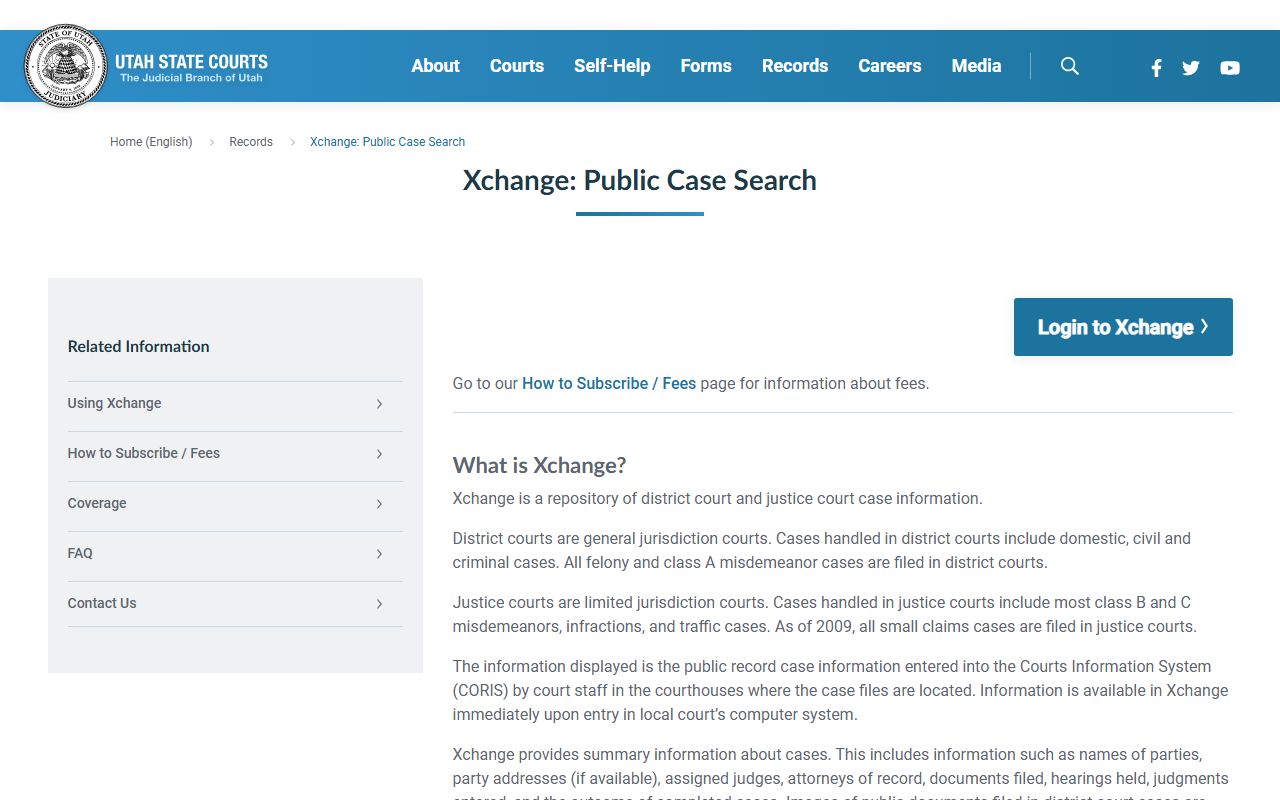
The Xchange screenshot supports the court-record search route that follows the jail roster and prosecutor filing step.
Find Court Records After Arrest
A careful search starts with the jail data and then moves into the court system. The jail record gives a booking date and may list an arresting agency, booking charge, bond, or hold. Those facts can narrow the court-record search, but the filed case may use a different charge description or statute.
- Search the Weber County current inmate roster to confirm the booking date and listed booking charge.
- Write down the defendant name, booking date, arresting agency, visible case number, and charge text if shown.
- Search Utah Courts Xchange by defendant name. Narrow by Weber County, criminal case type, court location, and date range when possible.
- Look for cases opened after the booking date. A prosecutor-filed charge can differ from the jail booking charge.
- Review each charge status, hearing, warrant, bond order, plea, dismissal, conviction, sentence, or expungement-related entry that is public.
- Use MyCase when party access is needed and the person is eligible to use that portal.
Older, sealed, restricted, or non-indexed court files may require direct court contact. Sheriff booking records and arrest reports are requested through the Weber County Sheriff's Office records and GRAMA process, while judicial records follow Utah court-access rules. Those are separate systems.
Arrest Charges and Court Records
After a Weber County jail arrest, the court record begins with a charging document or case filing. The prosecutor reviews law-enforcement reports and decides what to file. The filing may match the booking charge, but it may also change after evidence review, victim input, plea talks, or a legal screening decision.
| Document | What It Is | Why It Matters After Arrest |
|---|---|---|
| Complaint | Charging document commonly used to start many criminal cases. | Often the first formal court accusation after booking. |
| Information | Prosecutor-filed formal charge used in felony or misdemeanor prosecution after required proceedings. | May replace or refine the starting charge as the case moves forward. |
| Indictment | Grand-jury charging document. | Less common in ordinary local cases, but it is still a formal court charge. |
The distinction is practical. A roster can say one thing on the day of arrest, while court records later show amended, reduced, added, or dismissed counts. The court record controls the legal case history.
Weber County Charge Status
Court records after a jail arrest use status terms that describe where the charge stands. These terms should not be read as the same thing as guilt. A pending charge is an accusation. A dismissed charge is not a conviction. A reduced charge may replace a higher original allegation. A conviction depends on a guilty plea, no-contest plea where accepted, or verdict.
| Status | Plain-English Meaning |
|---|---|
| Pending | The charge is active and has not reached final disposition. |
| Amended | The filed charge or allegation changed after the case began. |
| Reduced | The charge was lowered to a lesser offense or level. |
| Dismissed | The charge was ended without a conviction on that count. |
| Pleaded | The defendant entered a plea recorded by the court. |
| Convicted | A plea or verdict resulted in a conviction. |
| Sentenced | The court imposed punishment, supervision, custody, or other conditions. |
Bond Holds and Arrest Records
Bond and holds connect the jail record to the court record. The Weber County booking page says booking staff inform the arrestee of the charges and bail required for release after booking is complete. The amount may be cash-only or bondable, and any holds are disclosed. Utah Code Title 77, Chapter 20 governs bail, release, and pretrial detention decisions.
| Bond or Hold Type | How It Affects Release |
|---|---|
| Cash bond | Full amount is paid to secure appearance, subject to jail and court instructions. |
| Surety bond | A licensed bail agent posts bond for a fee or collateral; no specific agent should be treated as endorsed. |
| Own recognizance / PR | Release on promise and conditions without posting full cash bail, set by the court. |
| No-bond hold | Ordinary bond release is not available at that moment. |
| Detainer or agency hold | Another court, county, state, federal agency, parole authority, or ICE matter may block release. |
Weber County research also notes that arrestees have an opportunity to make a collect phone call to try to make bail and that licensed bonding-company lists are available near inmate phones. Court-released inmates are released beginning at about 5 PM, while inmates who complete a sentence are released beginning at about 9 AM on the date time is served, according to the researched county booking material.
Warrants After Weber County Arrest
Warrants matter because many Weber County jail bookings start with an arrest warrant, bench warrant, fugitive warrant, or hold. The Weber County Sheriff's Office warrants page is the local entry point, and the Utah statewide warrant search is the official statewide public search identified in the research. A warrant may tie a current booking to an older court case.
A bench warrant often follows a missed court date. An arrest warrant authorizes arrest on a criminal matter. A search warrant is different and is not a jail-roster lookup tool. A fugitive or hold warrant can involve another county, state, or federal agency. Resolving a warrant may require court appearance, bond, a motion to recall or quash, legal counsel, or surrender. Payment alone may not clear the warrant.
Charges Versus Convictions
Public court records after an arrest should be read with the difference between a charge and conviction in mind. A charge is the formal accusation filed in court. A conviction is a later result based on plea or verdict. The gap between those two words is one reason the jail roster should not be used as a final background finding.
| Point | Charge | Conviction |
|---|---|---|
| Stage | Accusation after arrest or filing. | Final or later court outcome on the count. |
| Who controls it | Prosecutor files or amends it, subject to court process. | Court enters it after plea or verdict. |
| Meaning | Alleged conduct, not proof of guilt. | Legal finding or accepted plea. |
| Record caution | May be pending, dismissed, reduced, or amended. | May still be subject to appeal, set-aside, or expungement law. |
Sealed and Expunged Records
Utah public access law does not make every court or sheriff record public forever. Utah GRAMA governs requests to county agencies such as the sheriff, while court records are handled through judicial-branch access rules. Utah Code 63G-2-301 describes public records, and Utah Code 63G-2-302 describes private records. Utah Code Title 77, Chapter 40A governs expungement for eligible criminal records.
| Record Status | Plain-English Meaning | Weber County Search Effect |
|---|---|---|
| Sealed or restricted | Public access is limited or blocked by rule, order, or record classification. | Xchange, MyCase, clerk access, or sheriff records may not show the full file. |
| Expunged | Eligible criminal records are restricted through the Utah expungement process. | Agencies and courts may limit access or remove public display after the legal process is complete. |
| Private/protected | Records such as medical, juvenile, victim, witness, security, and some personal data may be withheld. | A GRAMA request can return partial records, denial, redaction, or instructions for appeal. |
Restricted Court Records After Arrest
Some Weber County court records after a jail arrest will not appear in a simple public search. Juvenile matters, sealed cases, expunged records, protected personal data, victim or witness information, medical material, security-sensitive records, and some ongoing investigative materials may be restricted. A missing public result does not prove there was no arrest, and a roster result does not prove the prosecutor filed the same charge.
Important: Court records, jail records, and warrant records can be incomplete or restricted; verify legal status with the court or agency that created the record.